Yes — and it is not usually a scam. It is a real price for a narrower piece of work than most patients assume. Here is the arithmetic, taken from an actual hospital quotation, so you can see exactly where the difference lives.
Updated November 2026. If you have been quoted RMB 5,000 for a dental implant in China — roughly USD 750 — and then found a Western-facing clinic quoting four to five times that, the natural conclusion is that somebody is lying. Usually nobody is. The two numbers describe different amounts of treatment, and neither party is obliged to spell that out.
This page does the spelling out. Below is a complete, itemised, hospital-issued quotation for one implant tooth. You can put it beside a RMB 5,000 offer and see precisely which lines are present, which are absent, and what the absent ones cost when you need them.
A RMB 5,000 offer almost always bundles three components: the titanium fixture, the abutment that connects it to the crown, and the crown itself. That is a genuine implant — three real parts, placed in your jaw by a real dentist. In the domestic Chinese market it is a normal price for an economy or mid-range implant system, and public hospitals perform hundreds of thousands of these every year.
What the price typically does not include:
None of that is dishonest. It is quoted-scope versus full-scope. The problem only starts when the two are compared as if they were the same thing.
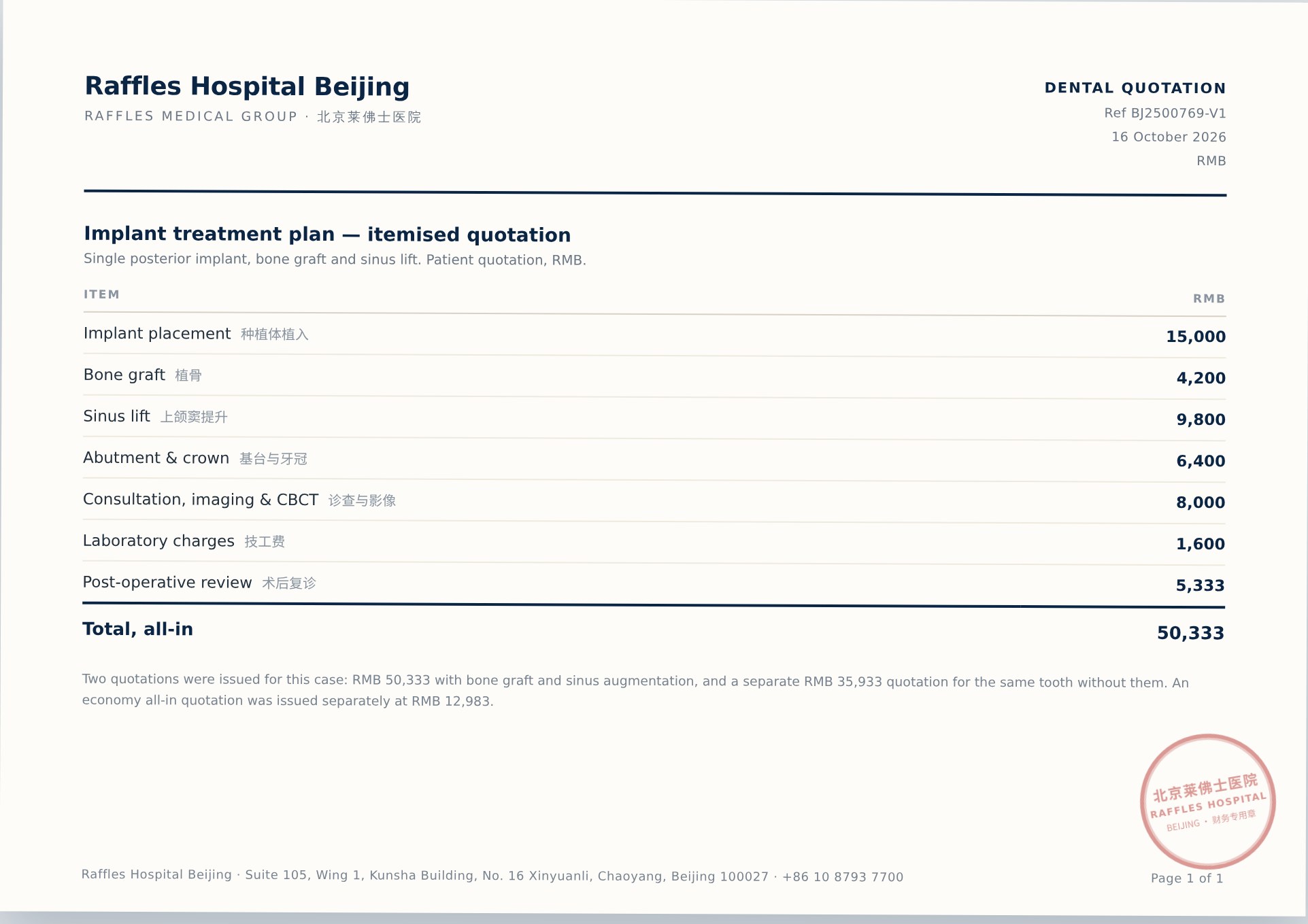
The table below is not an estimate or a market range. It is the single-tooth implant quotation issued by Raffles Hospital Beijing's international department — a Raffles Medical Group hospital in Chaoyang, Singapore-owned, with English-speaking clinicians. It is reproduced line for line, and it is the only hospital price sheet we are authorised to publish in full.
| Line item | RMB |
|---|---|
| Oral evaluation | 820 |
| CBCT — both jaws | 1,500 |
| Intraoral scan | 560 |
| Surgical implant guide | 3,155 |
| Implant fixture placement | 15,000 |
| Prefabricated abutment | 4,000 |
| Abutment-supported ceramic crown | 8,950 |
| Local anaesthesia | 280 |
| Implant consumables (2 sessions) | 1,112 |
| Restorative consumables | 556 |
| Total, one implant tooth | 35,933 |
 View full size ↗
Raffles Hospital Beijing financial-counselling form BJ2500769-V1, issued 31 July 2025. At an indicative USD 0.14987 per CNY (ECB, 3 November 2026) the total is about USD 5,385.
If the case also needs grafting, two further lines apply: bone graft at the first site RMB 7,200, and sinus augmentation RMB 7,200 — bringing the same single tooth to RMB 50,333.
Notice what dominates this quote. The implant fixture is RMB 15,000 of the RMB 35,933. Everything else — the imaging, the guide, the abutment, the crown, the anaesthetic, the consumables, the visits — is RMB 20,933. A large fraction of a real implant case is not the implant.
Put the two side by side. A RMB 5,000 offer bundles fixture, abutment and crown. The Raffles itemisation prices those same three components at RMB 27,950 — before any diagnostics, guide, anaesthesia or consumables. So even on identical scope, the gap is mostly brand and grade, not hidden fees.
Raffles places Straumann, a Swiss system with a published long-term evidence base and a documented prosthetic interface. Economy systems at RMB 5,000 are typically Korean or domestic brands. Many of them are perfectly respectable and have their own clinical literature. They are not the same product, and the price difference between a Swiss and a Korean fixture is a real, visible market fact — not an agency mark-up.
The remaining difference is everything the cheap quote left out. Diagnostics, guide, anaesthesia and consumables come to roughly RMB 7,983 in the Raffles itemisation. Those costs do not vanish because a quotation omitted them; they appear later, at the point where you cannot decline them.
So the honest comparison is three prices, not two:
| Scenario | RMB | USD, indicative |
|---|---|---|
| Bundled economy implant, routine site, no imaging or guide billed | 5,000 | 749 |
| Same economy implant, full diagnostics, guide, anaesthesia, consumables added | ≈12,983 | ≈1,946 |
| Straumann case at Raffles, itemised in full | 35,933 | 5,385 |
| Raffles, with bone graft and sinus lift | 50,333 | 7,543 |
The middle row is the one patients are rarely shown. It is what the RMB 5,000 quote becomes once the same standard of care is applied — and at that point the gap to a premium brand narrows to something you can weigh on its merits.
Ask these of every clinic, in China or anywhere else. A written answer to all ten is worth more than any discount.
It is worth saying plainly: a RMB 5,000 implant is often a good decision. If you have a single missing molar, adequate bone, no sinus involvement, and you are being treated in a public or reputable private clinic with proper imaging, an economy implant placed well will very likely serve you for many years. Implant survival depends far more on bone quality, surgical technique and hygiene than on the badge on the fixture.
The expensive option earns its price in specific circumstances: compromised bone requiring grafting, upper posterior sites near the sinus, patients with bruxism or uncontrolled diabetes, multiple adjacent implants, or a history of previous implant failure. It also earns it when you value a documented prosthetic interface and a manufacturer with decades of published survival data.
What is never a good decision is comparing a full-scope premium quote with a narrow-scope economy quote and assuming the difference is someone's commission. That comparison has cost a lot of patients a lot of money — sometimes by driving them to an expensive clinic they did not need, more often by landing them in a cheap one that quietly skipped the CBCT.
We do not perform dentistry and we do not employ dentists. What we do is get you the itemised figures before you travel, from a named hospital, in writing — the same form of document reproduced above — so that the number you agree to is the number on the invoice. If a hospital in our network can treat your case, you receive a line-item quote covering diagnostics, surgery, prosthetics and follow-up, with the grafting costs stated up front rather than discovered mid-treatment.
If your case is straightforward and a RMB 5,000 implant at a local clinic is genuinely the right answer, we will tell you that too. The page you are reading exists because we would rather lose a booking than have a patient arrive expecting a five-thousand-yuan case and leave with a fifty-thousand-yuan bill.
See the full dental cost guide with per-implant and full-arch figures →
Is a RMB 5,000 dental implant a scam?
Usually not. RMB 5,000 is a normal price in China for an economy or domestic-brand implant covering the fixture, abutment and crown. It becomes misleading only when it is compared against a full-scope quote as though the two covered the same treatment.
What is left out of a RMB 5,000 implant quote?
Typically the CBCT scan, the surgical guide, bone grafting, sinus augmentation, anaesthesia, consumables and follow-up visits. In the Raffles Hospital Beijing itemisation those excluded lines add RMB 7,983 on a straightforward site, and RMB 22,383 once grafting and a sinus lift are required.
Why is a Straumann implant so much more expensive?
In the Raffles quotation the Swiss-made fixture alone is RMB 15,000 of the RMB 35,933 total. The gap against an economy implant is product grade and brand, not hidden fees. Economy implants have their own clinical literature and can serve well when placed properly.
How much does a complete single implant tooth cost in China?
From an itemised hospital quotation, RMB 35,933 for one tooth including evaluation, imaging, surgical guide, fixture, abutment, crown, anaesthesia and consumables. With bone graft and sinus augmentation at the same hospital the same tooth totals RMB 50,333.
How many visits does a dental implant take?
A conventional implant typically requires two surgical sessions plus a restorative visit, spread over several months to allow the bone to integrate before the crown is fitted. Single-visit immediate-loading protocols exist but only suit selected sites, and a clinic should tell you whether your case qualifies.
What should I ask before accepting any implant quote?
Which implant system and manufacturer, whether a CBCT scan and surgical guide are included, the grafting and sinus-lift prices in writing, how many visits over how long, the operator's credentials, the warranty terms and what voids them, and the agreed remedy if the implant fails.
Most medical-tourism sites hide behind a contact form. Here is exactly who answers, and what they can and cannot do for you.
Every enquiry is assigned to a single medical coordinator who owns your file end to end — not a rotating inbox. You get their direct email and an answer within one business day.
Coordinators do not diagnose or give medical advice, and we will never pretend otherwise. Eligibility and treatment decisions come from the treating hospital's own physicians, in writing.
You receive the hospital name, department, treating physician, and an itemised all-in quote before any payment. If we can't name the clinic, we don't take your money.
You pay the hospital directly, at the price fixed in writing before you commit — never up front to an intermediary. If a stage is not delivered, it is not payable. How payment works →
No paid reviews. No invented patient stories. If you want to speak to a coordinator before sharing any records, email [email protected] and ask for a 20-minute call — free, no obligation.
Send your diagnosis and we'll shortlist clinics and give you a transparent, line-item quote within one business day. No obligation, no pressure.
Fields marked * are required. Your information stays private.
💬 Get your estimate on WhatsApp — usually replies within minutesNo obligation. Your details stay private.